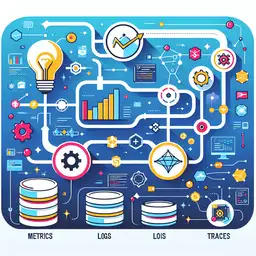
Combining Metrics, Logs, and Traces Effectively
Combining metrics, logs, and traces effectively is essential for DevOps engineers and SREs to achieve full-stack observability in modern distributed systems. This unified approach reduces mean time to resolution (MTTR), pinpoints root causes, and enables proactive issue detection…

Combining Metrics, Logs, and Traces Effectively
Combining metrics, logs, and traces effectively is essential for DevOps engineers and SREs to achieve full-stack observability in modern distributed systems. This unified approach reduces mean time to resolution (MTTR), pinpoints root causes, and enables proactive issue detection by correlating quantitative trends, detailed events, and request flows into a single narrative[1][2][4].
Why Combining Metrics, Logs, and Traces Effectively Matters
Traditional monitoring silos force teams to juggle multiple tools, leading to fragmented views, delayed debugging, and increased downtime. Metrics track aggregate performance like latency or error rates over time, logs capture granular events such as errors or payloads, and traces reveal end-to-end request paths across services[2][5]. When combined effectively, they transform isolated data into actionable insights—for instance, linking a spike in error metrics to specific slow spans in a trace and correlating error logs via trace IDs[1][3].
Platforms like Datadog and OpenObserve demonstrate this by unifying data in shared storage and query layers, enabling single-click triage: an alert on high response times jumps to traces, then to contextual logs[1][4]. Benefits include shorter MTTR, fewer escalations, and business-aligned outcomes like reduced revenue risk from downtime[4][5]. For SREs, this supports SLO enforcement with built-in alerting on burn rates[4].
The Three Pillars: Metrics, Logs, and Traces
Metrics: Detecting Trends and Anomalies
Metrics provide quantitative summaries—think CPU usage, request rates (e.g., http_server_duration_count), or custom KPIs like error rates. Use them for alerting on thresholds, such as average checkout API response time exceeding 500ms[1][2]. Tools like Prometheus query these for dashboards, triggering investigations[3][5].
Logs: Capturing Detailed Events
Logs offer moment-specific details: error messages, request payloads, or stack traces. They become powerful when enriched with trace context, like injecting trace_id and span_id for correlation[3]. This turns logs into diagnostic narratives tied to user requests[2].
Traces: Mapping Request Flows
Distributed traces visualize service interactions, highlighting bottlenecks, database delays, or API timeouts. Each span includes entry/exit points, errors, and attributes like service.name or k8s.pod.name[1][3]. Correlating traces with metrics and logs reveals why a metric spiked[5].
Practical Strategies for Combining Metrics, Logs, and Traces Effectively
To combine these signals effectively, standardize instrumentation with OpenTelemetry (OTel), enrich data with shared attributes, and use unified backends like Grafana stack (Prometheus, Loki, Tempo) or Datadog[3][4][9]. Here's an actionable workflow:
- Instrument with OTel: Auto-instrument apps or use SDKs to generate traces, metrics, and logs with consistent resource attributes (e.g., service name, pod).
- Enrich Logs: Inject trace context into every log entry for seamless querying.
- Correlate via Attributes: Query across systems using common keys like
trace_id,service_name. - Visualize and Alert: Build dashboards linking metrics alerts to traces/logs; set SLOs on unified views.
- Test Correlation: Validate end-to-end with scripts checking data propagation.
This reduces manual correlation, moving from reactive firefighting to predictive reliability[1][4].
Hands-On Example: Go Logger with Trace Injection
Start by enriching logs with trace context using Go's slog and OTel. This custom handler adds resource attributes and span details to every log[3].
// logger.go (excerpt)
package main

import (
    "log/slog"
    "os"
    "context"
    "go.opentelemetry.io/otel/sdk/resource"
    "go.opentelemetry.io/otel/trace"
)

type ResourceHandler struct {
    handler slog.Handler
    attrs   []any // Resource attributes
}

func (h *ResourceHandler) Handle(ctx context.Context, r slog.Record) error {
    // Add resource attributes to every log
    for _, attr := range h.attrs {
        r.AddAttrs(attr)
    }
    // Extract and add trace context
    span := trace.SpanFromContext(ctx)
    if span.SpanContext().IsValid() {
        r.AddAttrs(
            slog.String("trace_id", span.SpanContext().TraceID().String()),
            slog.String("span_id", span.SpanContext().SpanID().String()),
        )
    }
    return h.handler.Handle(ctx, r)
}

// Init logger with resource
func initLogger(res *resource.Resource) {
    attrs := res.Attributes()
    handler := slog.NewJSONHandler(os.Stdout, &slog.HandlerOptions{Level: slog.LevelInfo})
    wrapped := &ResourceHandler{handler: handler, attrs: attrs}
    logger := slog.New(wrapped)
    slog.SetDefault(logger)
}
Deploy this in your service. Logs now include {service_name: "payment-service", trace_id: "abc123", ...}, queryable in Loki[3].
Verification Script: Testing Correlation
Validate combining metrics, logs, and traces effectively with a Python test hitting your service, extracting trace_id, and querying Tempo (traces), Prometheus (metrics), and Loki (logs)[3].
# test_correlation.py (excerpt)
import requests
import time
from prometheus_api_client import PrometheusConnect

def test_signal_correlation():
    # Trigger telemetry
    response = requests.post(
        'http://payment-service.production.svc.cluster.local/charge',
        json={'amount': 100.00, 'customer_id': 'test-123'}
    )
    trace_id = response.headers.get('X-Trace-Id')
    assert trace_id, "No trace ID"
    time.sleep(5)  # Propagation delay

    # Query trace (Tempo)
    trace_resp = requests.get(f'http://tempo:3100/api/traces/{trace_id}')
    assert trace_resp.status_code == 200
    trace_data = trace_resp.json()
    service_name = next(a['value']['stringValue'] for a in trace_data['batches']['resource']['attributes'] if a['key'] == 'service.name')
    pod_name = next(a['value']['stringValue'] for a in trace_data['batches']['resource']['attributes'] if a['key'] == 'k8s.pod.name')

    # Query metrics (Prometheus)
    prom = PrometheusConnect(url='http://prometheus:9090')
    metrics = prom.custom_query(f'http_server_duration_count{{service_name="{service_name}", k8s_pod="{pod_name}"}}')
    assert len(metrics) > 0

    # Query logs (Loki)
    loki_resp = requests.get('http://loki:3100/loki/api/v1/query_range', params={
        'query': f'{{service_name="{service_name}", k8s_pod="{pod_name}", trace_id="{trace_id}"}}',
        'limit': 100
    })
    assert loki_resp.status_code == 200
    logs = loki_resp.json()['data']['result']
    assert len(logs) > 0
    print(f"Correlated trace {trace_id} successfully!")

test_signal_correlation()
Run this in CI/CD to ensure observability pipelines work. Success confirms metrics alert → trace isolation → log details flow[3][5].
Real-World Debugging Workflow
Alert: Checkout API latency >500ms (Prometheus metric)[1].
- Jump to traces (Tempo): Identify slow "charge" span in payment-service.
- Filter logs (Loki):
{trace_id="abc123"}reveals DB timeout payload. - Correlate metrics: Pod-specific
http_server_durationconfirms[3]. - Fix: Scale DB or optimize query; verify post-deploy.
This single-click journey, powered by OTel attributes, cuts MTTR from hours to minutes[1][4].
Best Practices for SREs and DevOps Teams
- Standardize with OTel: Use collectors for consistent export to backends[4].
- Shared Attributes: Mandate
trace_id,service.nameeverywhere[3]. - Unified Dashboards: Grafana for metrics/logs/traces linkage; Datadog for live correlation[1].
- Cost Optimization: Sample trace