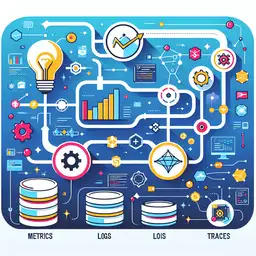
Combining Metrics, Logs, and Traces Effectively
Combining metrics, logs, and traces effectively is essential for DevOps engineers and SREs to achieve full-stack observability, enabling faster root cause analysis, reduced MTTR (Mean Time to Resolution), and proactive issue resolution in complex distributed systems.[1][2][4]

Combining Metrics, Logs, and Traces Effectively
Combining metrics, logs, and traces effectively is essential for DevOps engineers and SREs to achieve full-stack observability, enabling faster root cause analysis, reduced MTTR (Mean Time to Resolution), and proactive issue resolution in complex distributed systems.[1][2][4]
In modern microservices architectures, siloed tools lead to fragmented visibility, wasting time on manual correlation and increasing downtime risks. A unified approach integrates these three pillars—metrics for quantitative trends, logs for detailed events, and traces for request flows—into a single narrative that reveals not just what happened, but why.[1][5]
Understanding the Three Pillars of Observability
Metrics provide aggregated, time-series data like CPU usage, error rates, latency (e.g., RED metrics: Rate, Errors, Duration), and throughput. They excel at detecting anomalies over time via dashboards and alerts in tools like Prometheus or Grafana.[2][5]
Logs capture unstructured or semi-structured event details, such as error messages, request payloads, and stack traces. They offer context for "moment-specific" investigations but become overwhelming without correlation.[2][3]
Traces, powered by distributed tracing (e.g., OpenTelemetry or Jaeger), map end-to-end request paths across services, highlighting bottlenecks, slow spans, and service dependencies.[1][3]
Combining metrics, logs, and traces effectively turns isolated data into actionable insights. For instance, metrics alert on latency spikes, traces isolate the faulty service, and logs reveal the exact error—reducing triage from hours to minutes.[1][4][5]
Why Combine Metrics, Logs, and Traces Effectively?
- Shorter MTTR: Correlated views eliminate tool-switching; click from a metric alert to related traces and logs.[1][4]
- Proactive Debugging: Spot cascading failures in Kubernetes or serverless environments before user impact.[1][5]
- Cost Efficiency: Unified storage (e.g., OpenObserve) avoids data duplication and scales economically.[4]
- SLO Alignment: Tie observability to business KPIs like revenue loss from outages via AI-driven analysis.[6]
Platforms like Datadog (800+ integrations) or OpenTelemetry-based stacks unify these signals, supporting Kubernetes, CI/CD, and cloud-native apps.[1][4]
Practical Strategies for Combining Metrics, Logs, and Traces Effectively
Start with standardized instrumentation using OpenTelemetry (OTel), the open standard for telemetry. It ensures consistent trace IDs, span IDs, and attributes across metrics, logs, and traces.[3][4]
1. Instrument Your Services with Trace Context
Embed trace context in logs to enable correlation. In Go, use OTel's SDK to enrich logs with resource attributes and span details. Here's a practical example:
// logger.go - Custom slog handler for OTel correlation
package main

import (
    "context"
    "log/slog"
    "os"
    "go.opentelemetry.io/otel/attribute"
    "go.opentelemetry.io/otel/sdk/resource"
    "go.opentelemetry.io/otel/trace"
)

func initLogger(res *resource.Resource) {
    // Extract resource attributes
    attrs := res.Attributes()

    handler := slog.NewJSONHandler(os.Stdout, &slog.HandlerOptions{
        Level: slog.LevelInfo,
    })

    // Wrap handler to add resource attributes and trace context to every log
    wrappedHandler := &ResourceHandler{
        handler: handler,
        attrs:   attrs,
    }
    logger := slog.New(wrappedHandler)
    slog.SetDefault(logger)
}

type ResourceHandler struct {
    handler slog.Handler
    attrs   []attribute.KeyValue
}

func (h *ResourceHandler) Enabled(ctx context.Context, level slog.Level) bool {
    return h.handler.Enabled(ctx, level)
}

func (h *ResourceHandler) Handle(ctx context.Context, r slog.Record) error {
    // Add resource attributes to every log record
    for _, attr := range h.attrs {
        r.AddAttrs(slog.String(string(attr.Key), attr.Value.AsString()))
    }

    // Extract trace context if present
    span := trace.SpanFromContext(ctx)
    if span.SpanContext().IsValid() {
        r.AddAttrs(
            slog.String("trace_id", span.SpanContext().TraceID().String()),
            slog.String("span_id", span.SpanContext().SpanID().String()),
            slog.Bool("trace_flags.sampled", span.SpanContext().IsSampled()),
        )
    }
    return h.handler.Handle(ctx, r)
}

func (h *ResourceHandler) WithAttrs(attrs []slog.Attr) slog.Handler {
    return &ResourceHandler{
        handler: h.handler.WithAttrs(attrs),
        attrs:   h.attrs,
    }
}

func (h *ResourceHandler) WithGroup(name string) slog.Handler {
    return &ResourceHandler{
        handler: h.handler.WithGroup(name),
        attrs:   h.attrs,
    }
}
This handler automatically injects trace_id and span_id into logs, allowing queries like "filter logs by trace_id from a slow metric alert."[3]
2. Set Up Correlation in Your Observability Platform
- Export Telemetry: Use OTel Collector to route metrics (Prometheus), traces (Jaeger/Zipkin), and logs to a backend like Grafana Tempo, Loki, and Mimir—or a unified store like OpenObserve.[4]
- Link by Context: Ensure shared keys (e.g.,
service.name,trace_id). In Grafana, use TraceQL or LogQL to jump between views:{service="checkout"} | json | traceID="abc123". - Alerting Workflow: Prometheus alerts on metrics trigger Grafana dashboards showing top traces and correlated logs.[5]
3. Real-World Debugging Scenario
Scenario: Checkout API latency spikes (metric alert).[1][5]
- Step 1: Metric dashboard shows p95 latency > 500ms on
checkout-service. - Step 2: Pivot to traces: Identify slow span in
payment-gatewaycall (e.g., 400ms DB query). - Step 3: Filter logs by trace_id: Reveals "DB connection timeout" with payload details.
- Action: Scale DB connections; verify with SLO burn-rate alerts.[4]
This single-click flow, seen in Datadog or Grafana, cuts MTTR by 50-70%.[1]
Best Practices for DevOps and SRE Teams
- Uniform Sampling: Use head-based sampling in OTel to ensure traces represent high-error requests, correlating to metrics.[4]
- Context Propagation: Always propagate trace context via HTTP headers (W3C Traceparent) in services.[3]
- Dashboard Templates: Build Grafana dashboards with Loki/Traces/Metrics panels linked by variables (e.g.,
${traceId}). - Cost Optimization: Aggregate metrics at high cardinality; sample traces/logs; use columnar stores like OpenObserve.[4]
- AI Enhancements: Leverage ML for anomaly detection tying traces to business impact (e.g., revenue per request).[6]
For SREs, integrate with on-call tools like PagerDuty: Alerts include trace summaries and log snippets for instant context.[5]
Grafana-Specific Implementation Tips
As a Grafana expert, recommend the "Three Pillars" stack: Loki (logs), Tempo (traces), Mimir/Prometheus (metrics). Use Explore view for ad-hoc correlation:
// Example LogQL query combining metrics, logs, traces effectively
sum(rate({job="checkout"}[5m])) by (le)  // Metrics: Latency histogram
|> line_format "{{.traceID}}"              // Extract traceID
|> label_format traced="true"              // Link to Tempo
Install Grafana Agent for OTel collection: Auto-instruments apps, exports unified telemetry.[4]
Overcoming Common Challenges
High cardinality? Downsample metrics, use exemplars linking to traces.[2] Data volume? Unified platforms reduce storage by 5x via deduplication.[4] Adoption? Start small: Instrument one service, measur