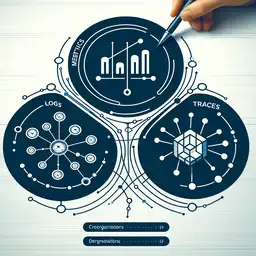
Visualising Transaction Paths Across Services
In modern microservices architectures, visualising transaction paths across services is essential for DevOps engineers and SREs to diagnose performance issues, identify bottlenecks, and ensure system reliability. Distributed tracing tools capture every step of a request's journey, providing clear…

Visualising Transaction Paths Across Services
In modern microservices architectures, visualising transaction paths across services is essential for DevOps engineers and SREs to diagnose performance issues, identify bottlenecks, and ensure system reliability. Distributed tracing tools capture every step of a request's journey, providing clear visualizations that reveal dependencies, latencies, and errors in real-time[1][2][3].
Why Visualising Transaction Paths Across Services Matters
Microservices introduce complexity with requests spanning dozens of services, databases, and external APIs. Without proper visibility, troubleshooting becomes a nightmare—logs scatter across systems, metrics lack context, and errors propagate silently. Visualising transaction paths across services solves this by grouping related operations into traces, showing the exact flow, timing, and failure points[1][3].
Key benefits include:
- Pinpointing bottlenecks: See which service consumes the most time in a transaction[2][3].
- Mapping dependencies: Automatically generate service topologies to understand communication patterns[1].
- Root cause analysis: Isolate the originating service in error cascades, eliminating manual log digging[1].
- End-to-end latency measurement: Track total request duration across boundaries[3].
- Unexpected interaction detection: Spot hidden calls that degrade performance[3].
For SREs, this visibility supports SLO enforcement; for DevOps, it accelerates incident response and deployment confidence[7]. Tools like those based on Google's Dapper paper enable low-overhead tracing, making it feasible at scale[1].
Core Concepts in Visualising Transaction Paths Across Services
Distributed tracing breaks transactions into traces and spans. A trace represents a complete user request journey, while spans are individual operations within services, including start time, duration, and metadata[3]. Trace context—via correlation IDs—propagates across services, linking spans into coherent paths[1][3].
Visualizations typically include:
- Waterfall charts: Timeline views showing sequence, duration, and parallelism of calls[2].
- Service maps: Graphs of inter-service dependencies with health metrics like RPM and response times[1].
- Flame graphs: Hierarchical breakdowns of CPU, wait, and execution times per span[2].
These render as interactive trees or graphs, color-coding errors (e.g., red for failures) and highlighting slow segments[1][2].
Practical Tools for Visualising Transaction Paths Across Services
Several APM tools excel here. Dynatrace's PurePath tracks requests end-to-end, filtering by service chains like Authentication calls[2]. New Relic and Splunk APM offer similar workflows for business-critical transactions, such as e-commerce checkouts[7][8]. Open-source options like Jaeger or Zipkin integrate with Grafana for custom dashboards.
In Grafana with Tempo (open-source tracing), you query traces by trace ID and visualize paths via service graphs. This pairs with Loki logs and Prometheus metrics for full observability.
Hands-On Example: Instrumenting a Node.js Microservices App
Consider a simple e-commerce system: Frontend → Authentication → Payment → Inventory services. We'll use OpenTelemetry (OTel) for instrumentation—standardized, vendor-agnostic tracing.
Step 1: Install OTel in Node.js Services
Add dependencies:
npm install @opentelemetry/api @opentelemetry/sdk-node @opentelemetry/exporter-trace-otlp-http @opentelemetry/instrumentation-express @opentelemetry/instrumentation-httpInitialize in each service (e.g., auth-service.js):
const opentelemetry = require('@opentelemetry/sdk-node');
const { getNodeAutoInstrumentations } = require('@opentelemetry/auto-instrumentations-node');
const { OTLPTraceExporter } = require('@opentelemetry/exporter-trace-otlp-http');

const exporter = new OTLPTraceExporter({
  url: 'http://localhost:4318/v1/traces', // Tempo or Jaeger endpoint
});

const sdk = new opentelemetry.NodeSDK({
  traceExporter: exporter,
  instrumentations: [getNodeAutoInstrumentations()],
});

sdk.start();
Express app example:
const express = require('express');
const { trace } = require('@opentelemetry/api');

const app = express();

app.post('/authenticate', async (req, res) => {
  const tracer = trace.getTracer('auth-service');
  return tracer.startActiveSpan('authenticate-user', async (span) => {
    try {
      // Simulate DB call or payment service
      await new Promise(resolve => setTimeout(resolve, 50)); // 50ms latency
      span.setAttribute('user.id', req.body.userId);
      span.end();
      res.json({ success: true });
    } catch (error) {
      span.recordException(error);
      span.setStatus({ code: 2, message: error.message });
      res.status(500).json({ error: 'Auth failed' });
    }
  });
});

app.listen(3001);
Repeat for Payment and Inventory, propagating headers automatically via OTel HTTP instrumentation[1]. Export to Grafana Tempo.
Step 2: Query and Visualize in Grafana
- Configure Tempo datasource in Grafana.
- Create dashboard with Trace View panel: Search by service name or trace ID.
- Add Service Graph: Visualizes dependencies with edge latencies.
A sample trace for checkout might show:
- Frontend (100ms total): Calls Auth (50ms), parallel Inventory check (30ms).
- Payment (80ms): Sequential DB span (20ms) + external API (60ms, red for error).
Waterfall reveals Payment as bottleneck—drill into code-level spans for method timings[2].
Grafana Dashboard JSON Snippet
{
  "targets": [{
    "datasource": "Tempo",
    "query": "service.name=\"payment-service\"",
    "serviceGraph": true
  }],
  "type": "trace"
}
Advanced Techniques for SREs
Filter by business workflows: In Splunk APM, define checkout spans; visualize only relevant paths, highlighting error-impacted services[7]. Dynatrace PurePath filters chains, e.g., Frontend → Auth → MongoDB[2].
Team-specific views: Pivot traces by service ownership—Auth team ignores Frontend noise[2].
Alerting on traces: Thresholds on p95 latency per path trigger PagerDuty. Correlate with metrics: High RPM + slow spans = capacity issue[1].
Grafana Tempo + Loki example query:
{service="frontend"} != "health" | json | traceID="{{.traceID}}"This links logs to traces for full context.
Best Practices for Visualising Transaction Paths Across Services
- Start small: Instrument critical paths (e.g., checkout) before full rollout[3].
- Propagate context: Always forward trace headers in async calls[1].
- Sample intelligently: Head-based (100% critical paths) or tail-based sampling for errors[8].
- Integrate with CI/CD: Fail builds if trace error rate >5%.
- Monitor overhead: OTel adds <1% CPU; validate in prod[1].
Troubleshoot common pitfalls: Missing spans indicate propagation failures—check middleware. No service map? Ensure bidirectional tracing[1].
Real-World Impact
Teams using these visualizations reduce MTTR by 50-70%: Dynatrace PurePaths expose client-side waits; Trace service maps predict overloads[1][2]. In 2026's hybrid cloud era, visualising transaction paths across services is non-negotiable for resilient systems[3].
Implement today: Spin up Tempo in Kubernetes, instrument one service, and query your first trace. Scale to production for actionable insights that keep SLIs green.
(Word count: 1028)